Blog

How Dangerous is it to Replace a Garage Door Spring Yourself? Why You Should Always Call A Pro

A broken garage door spring is one of the most common calls Mark’s Garage Doors gets from homeowners throughout Marin and Sonoma Counties.

The door won’t open. The opener strains and stops. Sometimes there’s a loud bang from the garage that sounds like a gunshot. From that point, plenty of homeowners head straight to a hardware store or YouTube, convinced this is a weekend fix. It usually isn’t.

After 24 years of garage door repair in Sonoma County, the team has seen enough close calls, hospital stories, and expensive redo jobs to say it plainly: spring replacement is not a DIY project. This blog walks through why the job looks easy, why it isn’t, and what makes professional spring replacement worth every dollar.

Key Takeaways

  • Garage door springs hold hundreds of pounds of stored energy, even when the door is closed.
  • The repair looks straightforward on video but hides several failure points a homeowner can’t see.
  • Wrong-sized springs, cross-threaded cones, and worn cables cause repeat breaks within months.
  • DIY spring jobs send people to Sonoma County emergency rooms every year with hand, face, and eye injuries.
  • Mark’s Garage Doors replaces springs as a full system service, including cables, drums, and balance testing.
  • A professional spring replacement typically costs less than the ER visit or second call-out a botched DIY creates.

Springs Do the Heavy Lifting

Every sectional garage door in a home relies on a spring system to counterbalance the weight of the door itself.

  • A standard double door weighs 150 to 250 pounds
  • A wood or carriage-house door can push past 400


Without a working spring, the opener alone can’t lift that weight, and it isn’t designed to try.

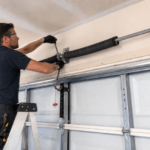
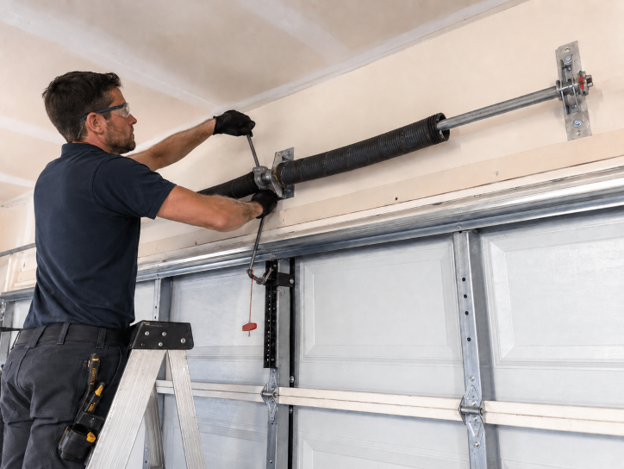
Torsion springs sit on a shaft above the door. Extension springs run along the horizontal tracks on either side. Both types store energy under high tension.

When a spring is wound to hold a 200 pound door, it holds that force whether the door is up, down, or halfway. That energy doesn’t go away when the spring breaks. It goes somewhere else, usually fast.

The Hidden Danger in a "Simple" Spring Replacement

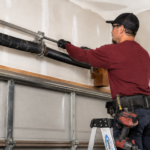
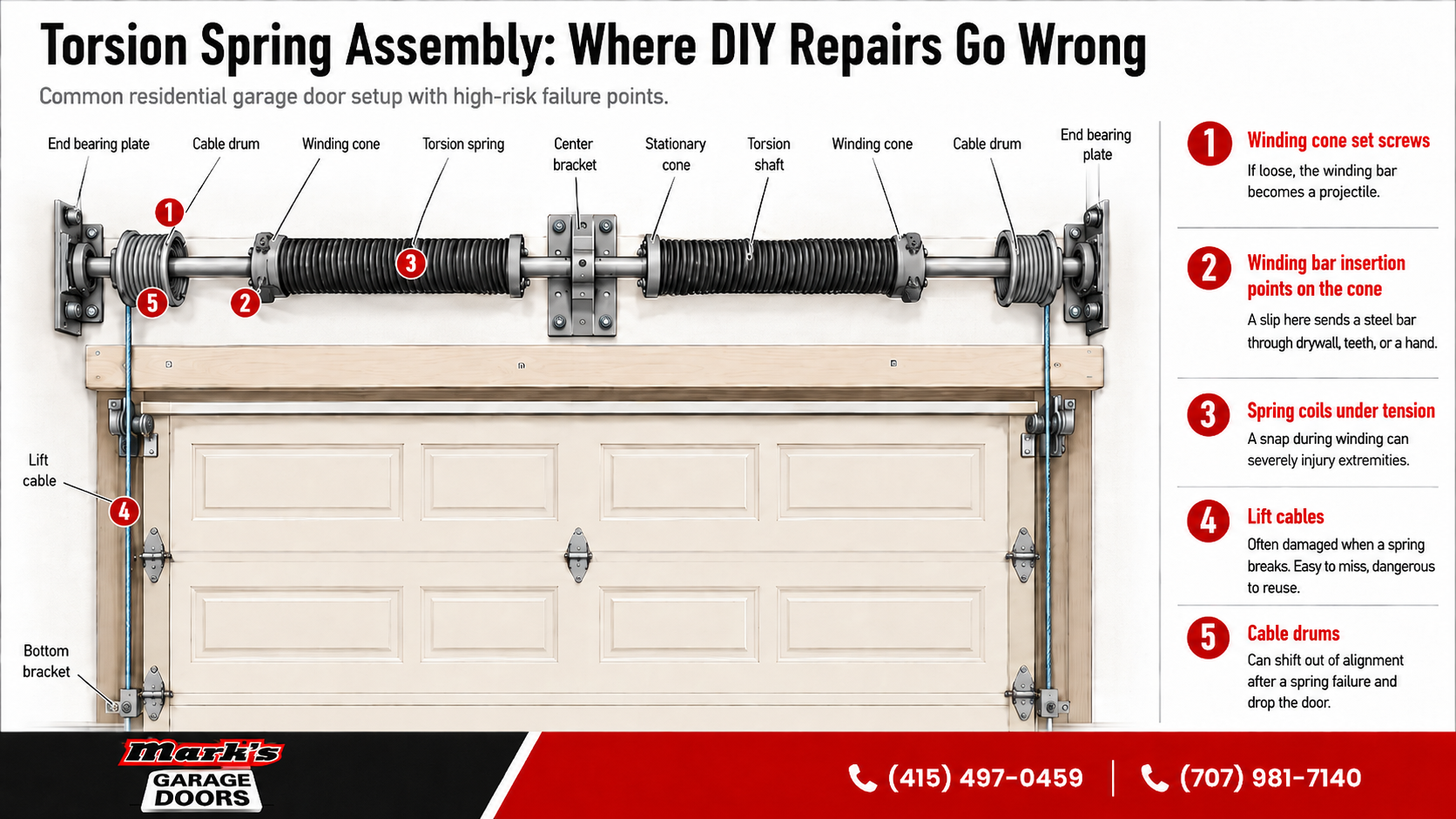
Torsion spring assembly safety guideSearch “garage door spring replacement” and you’ll find videos that make the job look like changing a light fixture. Loosen two bolts. Unwind the old spring. Slide on a new one. Wind it back up. Done in 30 minutes.

What those videos skim past is the part where things go wrong.

Winding Bars Slip

Torsion springs are wound with two steel bars inserted into the cone.

If a bar isn’t seated correctly, or the cone set screws aren’t tight, the bar becomes a projectile. Homeowners have lost teeth, broken jaws, and taken bars through drywall this way.

Springs Snap During Installation

A spring under load can fail mid-wind. When it does, the coil unwinds violently through whatever’s in the way. Hands and forearms are the most common casualties.

The Wrong Spring Makes the Door Even More Dangerous

Springs are rated by wire size, inside diameter, and length.

A spring that’s close but not correct will over-tension or under-tension the door, wear out the opener, and often break again within a year.

The Risk You Can't See

The bigger problem with DIY spring work isn’t the spring itself. It’s everything the spring is connected to.

When a spring fails:

  • The cables often take damage from the sudden shift in load
  • The drums can shift out of alignment
  • Bearings can crack


If a homeowner replaces only the spring and re-tensions the door, the next weak point takes the hit. That might be a cable snapping while someone is standing under the door. It might be a drum letting go a week later while the car is halfway out.

Professional garage door repair in Sonoma County includes checking the whole system:

  • Cables
  • Drums
  • Rollers
  • Bearings
  • Hinges
  • The door balance itself


A spring change without that inspection is a temporary fix at best
.

DIY Spring Repair Usually Costs More

The pitch for DIY is usually the price. A spring runs 30 to 100 dollars at a hardware store. A service call runs more. On paper, the math looks obvious.

Here’s what the math misses.

  • Hardware store springs are often generic and mismatched to the door.
  • Winding bars, vise grips, and correct-sized wrenches add up if you don’t own them.
  • A wrong install shortens opener life. Openers cost 400 to 800 dollars to replace.
  • An ER visit for a hand injury in Sonoma County runs into the thousands, even with insurance.
  • A second spring failure within a year means paying for the repair twice.


Homeowners who call a pro after a DIY attempt usually pay more than they would have paid the first time. That’s the pattern the team sees week after week.

What to Do When a Spring Breaks

If you hear a bang from the garage and the door won’t open, don’t try to force it with the opener. That’s the fastest way to burn out the motor or bend a track.

Unplug the opener. Leave the door where it is. Call for service.

The Professional Approach to Spring Repair

A professional team runs spring jobs as full system service, not a parts swap.

  • Measure the door, wire size, and spring specs to match the actual load
  • Replace both springs on a dual-spring door, even if only one broke, since the second is close behind
  • Inspect and replace cables, drums, and bearings as needed
  • Test door balance by hand before reconnecting the opener
  • Confirm the safety reverse and photo eyes work correctly before leaving


Mark’s Garage Doors’ trucks carry the common spring sizes for Sonoma County homes, so most repairs finish the same day the call comes in.

Skip the Risk, Call Mark's Garage Doors

A broken spring is a bad afternoon. It doesn’t need to become a hospital visit or a second repair bill. Mark’s Garage Doors has been handling spring replacements across Marin and Sonoma Counties for 24 years, with fair pricing and no upselling, and can usually get out same day.

Call Mark’s Garage Doors at (707) 981-7140 or contact us online to book a repair or ask a question.

Frequently Asked Questions

How long does a garage door spring last?

Most residential torsion springs are rated for 10,000 cycles, which works out to 7 to 12 years for the average home. Homes with a busy garage door or heavy wood doors wear springs out faster.

On a dual-spring door, yes. Both springs have gone through the same number of cycles. Replacing only the broken one means paying for another service call in a few months.

Not safely. The door will feel extremely heavy, and lifting it can strain your back or drop the door on your hands or feet. Leave it closed until a technician arrives.