A garage door has about a dozen moving parts, and when one of them acts up, you’re standing in the driveway trying to figure out whether it’s a five-minute fix or a full service call. Some problems are honestly that simple. Others involve parts under enough tension to send someone to the ER.
This guide walks through the five categories that cover almost every garage door problem you’ll run into: springs, cables, openers, tracks, and panels. For each one, you’ll see what you can handle yourself, what needs to wait for a technician, and how urgent the fix actually is.
If you’re searching for garage door repair in Sonoma County because something isn’t working right, this should help you figure out the next move before you pick up a wrench or the phone.
Key Takeaways
- Most garage door problems fall into 5 categories: springs, cables, openers, tracks, and panels.
- Springs and cables are the two components you should never work on yourself. They store enough tension to cause serious injury.
- Opener issues are often DIY-friendly at the surface level (remote batteries, sensor alignment, keypad codes), but internal repairs are not.
- Off-track doors, snapped cables, and doors stuck halfway are urgent and unsafe to keep operating.
- Loose hardware, worn weather stripping, and dirty tracks are safe weekend jobs for most homeowners.
- A working garage door gets a lot of use. Small problems turn into bigger ones fast when they’re ignored.
The 5 Parts That Cause Almost Every Garage Door Problem
Garage doors look complicated, but the failure points are pretty predictable. Nearly every repair traces back to one of these five parts:
- Springs: the coiled steel above the door (or on either side of it) that lifts most of the door’s weight
- Cables: the steel cables running from the bottom of the door up to the springs
- Opener: the motorized unit on the ceiling, plus its remote, wall button, sensors, and circuit board
- Tracks and rollers: the metal channels the door rides in, and the wheels that move through them
- Panels and hardware: the door sections themselves, plus hinges, brackets, weather stripping, and the bottom seal
Once you know which category your problem falls into, deciding when to DIY or when to call a pro gets a lot easier. The sooner you make that call, the better. Repairs are often most affordable when the problem is caught early on.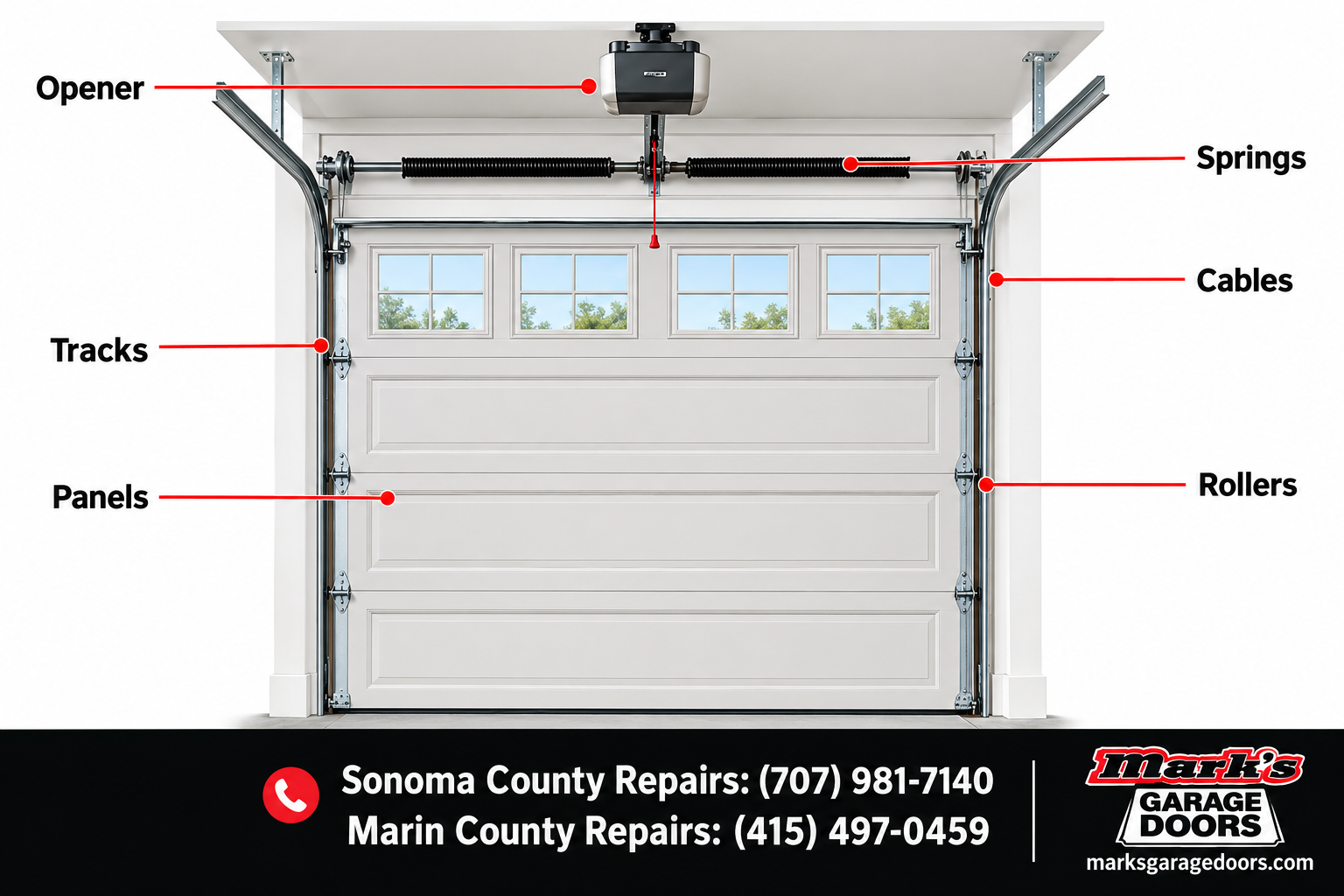
Springs: Never DIY, Always Call a Professional
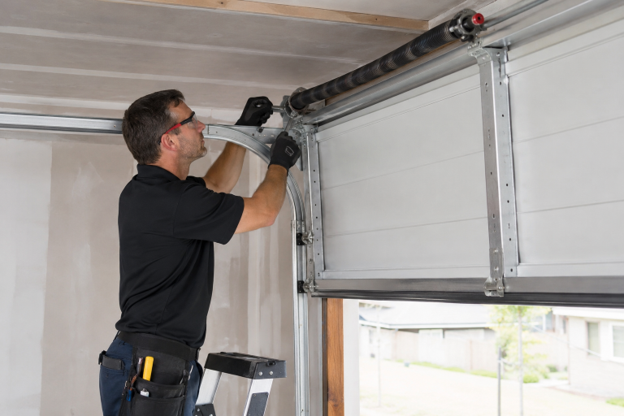
Torsion and extension springs do the actual heavy lifting on a garage door. A standard residential door weighs 150 to 400 pounds, and the springs are wound tight enough to move all of it. When a spring breaks, it releases that energy fast.
What can go wrong:
- Broken spring (you’ll usually hear a loud bang, and the door won’t open)
- Stretched or worn spring (door feels heavier, opener strains, door won’t stay open halfway)
- One spring broken on a two-spring system (still dangerous, still needs replacement)
DIY or pro 🛠️: Call a professional every time. Don’t try to unwind a torsion spring, don’t try to replace one, and don’t try to adjust the tension. Spring work needs specific winding bars and hands-on experience. Injuries from DIY spring repair are common and severe.
Urgency !: High. A door with a broken spring shouldn’t be operated with the opener. The opener isn’t built to lift the full weight and will burn out or damage other parts trying.
Cables: Never DIY, Always Call a Professional
Cables work with the springs. They wind and unwind around drums at the top of the door as it moves, and they carry the load when the springs are doing their job. A snapped cable often means a spring problem too, since the two are under related tension.
What can go wrong:
- Frayed or rusted cable (visible strands, usually near the bottom bracket)
- Snapped cable (door tilts to one side, or hangs crooked in the opening)
- Cable off the drum (door jams or won’t move evenly)
DIY or pro 🛠️: Pro. Cables sit under the same tension load as springs. Removing the bottom bracket where the cable attaches, without releasing tension properly, can cause the bracket to fly off with force.
Urgency !: High, if the cable is broken or the door is crooked. Do not run the door until it’s fixed. A frayed cable that hasn’t failed yet is medium urgency, book service within a few days.
Openers: Some DIY, Most Repairs Need a Pro
The opener is where DIY territory gets a little wider, because a lot of “my opener is broken” calls turn out to be simple fixes at the wall or sensor level.
Repairs You Can DIY Safely
- Replace remote batteries. Sounds obvious, but this is one of the most common service calls.
- Realign the safety sensors. The two small photo-eye sensors near the floor need to face each other with nothing blocking them. A bump from a bike or a stack of storage bins knocks them out of line. Loosen the wingnut, straighten the sensor until both indicator lights glow steady, tighten.
- Reprogram remotes or keypads. The opener’s manual has the steps. Usually a “learn” button on the motor unit and a press on the remote.
- Clear the sensor path. Cobwebs, leaves, or a bin in the way of the beam will make the door refuse to close.
- Check that the wall button works. If the wall button works but the remote doesn’t, the problem is the remote or sensors, not the opener itself.
Repairs That Require a Pro
- Motor issues, grinding noises, or humming without movement
- Stripped drive gears (common on older chain and belt drives)
- Circuit board failures
- Carriage or trolley problems
- Broken drive chains or belts
- Full opener replacement
- Openers that trip the circuit breaker
Urgency !: Depends on the needed repair. A door that won’t open because the batteries died is a same-day annoyance. A grinding opener that shakes the ceiling is a call-today problem before something breaks and drops.
Tracks and Rollers: Some DIY, Most Repairs Need a Pro
The tracks are the vertical and horizontal metal channels that guide the door up and over. Rollers are the wheels that ride inside them. When something’s wrong here, the door usually tells you with noise or by moving unevenly.
Repairs You Can DIY Safely
- Clean the tracks. Wipe out debris with a rag. Don’t lubricate the inside of the tracks (rollers need to roll, not slide).
- Lubricate rollers and hinges. Use a garage-door-specific lubricant, not WD-40. A few sprays on the rollers, hinges, and springs, twice a year. This alone quiets a lot of noisy doors.
- Tighten loose bolts and brackets. Vibration loosens hardware over time. A socket wrench and 15 minutes handles this.
Repairs That Require a Pro
- Bent tracks. Usually from being bumped by a car. A bent track needs to come off the wall and either be straightened or replaced.
- Door off the tracks. The rollers have jumped out of the channel. Don’t force it back. The door is heavy, unstable, and probably has a related problem (broken cable, worn roller, misaligned track) that caused the jump.
- Broken or worn rollers. Some rollers are held in by the hinge, which sits under load. Replacement isn’t hard, but doing it wrong can throw off the whole door.
- Track realignment. The tracks need to be perfectly plumb and parallel for the door to run smoothly. A quarter-inch off in either direction causes noise and premature wear.
Urgency !: An off-track door is high urgency. Don’t operate it. The door is carrying significant weight and without the rollers seated properly in the channel, it can shift, bind, or come down unevenly. Forcing it with the opener risks damaging the tracks, the panels, and the opener motor all at once.
Bent tracks are medium urgency. The door will still move, but the bend creates friction and uneven wear on the rollers every cycle. Noisy or dirty tracks are low urgency but worth handling soon. Wipe out the debris, skip the lubricant inside the track itself, and see if the noise settles.
Panels and Hardware: Some DIY, Cosmetic vs. Structural
Panels are the horizontal sections of the door itself. Hardware covers hinges, brackets, weather stripping, and the bottom seal.
Repairs You Can DIY Safely
- Replace the bottom weather strip. The rubber seal at the bottom of the door slides into a channel. Cut to length, feed it in, done. Home improvement stores in Santa Rosa and Petaluma carry the common sizes.
- Replace side and top weather stripping. Nailed or screwed to the frame. Straightforward.
- Wash and repaint the door. A weekend job. Use exterior paint rated for metal or wood, depending on your door.
- Touch up small dents and scratches on steel doors. Auto-body filler and paint. Doesn’t restore structural integrity, but it looks better.
Repairs That Require a Pro
- Replace a damaged panel. Panels are ordered by exact match to the door make and model. Getting the wrong one is a common DIY mistake. Panel replacement also requires releasing tension on the door safely.
- Repair a bent or buckled panel. Usually not repairable. Replacement is the answer.
- Replace hinges under load. The middle and top hinges on a garage door hold the panels together and carry weight. Some can be swapped safely, some can’t. If you’re not sure, don’t guess.
Urgency !: Cosmetic panel damage, low. Structural panel damage where the door is warping or won’t seal, medium to high. Broken hinges, high, because a failed hinge can cause the door to bind or collapse a section.
How Weather and Use Patterns Affect Garage Doors
Local conditions play a bigger role in garage door wear than most homeowners expect. A few things worth knowing if you live in the area:
- Coastal moisture and marine air. Homes closer to the coast in west Sonoma County deal with salt air and higher humidity. Cables and springs rust faster here, and steel doors need repainting more often than doors inland.
- Temperature swings between seasons. Summers in Santa Rosa and Petaluma regularly hit the 90s, and winter nights drop into the 30s. Metal parts expand and contract, which loosens hardware and dries out lubricant faster than in milder climates.
- Wildfire smoke and ash. During fire season, ash gets into tracks, rollers, and opener housings. A door that was quiet in June can start grinding by October if the tracks aren’t cleaned.
- High-cycle use. A garage door averages 3 to 5 open/close cycles a day. Homes where the garage is the main entry easily hit 8 or more. Springs are rated for cycles, not years, and higher use means shorter spring life.
Annual maintenance matters more in Sonoma County than in a lot of other regions. Small habits like lubricating twice a year and clearing debris from the tracks extend the life of every other part.
How to Know If You're Getting a Fair Quote
Pricing is one of the biggest reasons homeowners hesitate to call a professional. Here’s what fair, transparent garage door repair in Sonoma County typically involves:
- A clear diagnosis first. A technician should be able to identify the problem and explain it in plain language before quoting the fix.
- An itemized estimate. Parts, labor, and any additional work should be broken out so you know what you’re paying for.
- Repair vs. replace guidance. A trustworthy company will tell you when a repair makes sense and when the door or opener is at the end of its life. Both options should include a real cost comparison.
- No pressure to add on parts. If a technician recommends replacing something that isn’t clearly failing, ask why. A good answer includes specifics (visible wear, cycle count, safety risk).
- Warranty on parts and labor. Reputable shops stand behind their work. Ask what’s covered and for how long.
Typical residential repair costs in the area range from around $150 for minor adjustments to $400 or more for spring or cable replacement, with opener replacement running higher depending on the model.
When Garage Door Problems Become Safety Concerns
A few signs indicate the door has moved from “annoying” to truly unsafe:
- The door falls faster than it lifts, or slams shut instead of closing smoothly
- The door won’t stay open halfway when you disconnect the opener and try to hold it there
- You can hear or see gaps in the cable, or one side of the door hangs lower than the other
- The opener strains, hums, or shakes hard on every cycle
- The safety reversal doesn’t work (place a 2×4 flat on the floor under the door; if the door doesn’t reverse when it touches the wood, the safety feature has failed)
A garage door falling under its own weight is one of the most serious home injury risks in a house with kids or pets. If any of the above is happening, stop using the door and book service the same day.
Unsure If It's a DIY Job? Call for a Professional Inspection
Mark’s Garage Doors has been handling repairs like these across Sonoma and Marin Counties for over 24 years. Every service call starts with a clear diagnosis and an honest estimate before any work begins. No pressure, no unnecessary parts, and no runaround.
Contact us online or call Mark’s Garage Doors at (707) 981-7140 for trusted local service. Same-day service is available in most cases.
Frequently Asked Questions
Do I need to replace both springs if only one breaks?
Yes, and most technicians will recommend it. If one spring has broken, the other is close to the same age and the same wear point. Replacing both at once saves a second service call within months and keeps the door balanced.
Running a door with one new spring and one worn spring puts uneven load on the cables, tracks, and opener.
How often should a garage door be serviced?
Once a year for a professional tune-up covers most homes. Homeowners in Marin and Sonoma Counties with heavy daily garage door use (two or three cycles a day) benefit from annual service.
Basic lubrication and hardware tightening every 6 months between service calls extends the life of the door.
Can a damaged garage door panel affect how the door operates?
Yes. A panel that’s buckled or warped can throw off the alignment of the whole door, causing it to bind in the tracks, put extra strain on the opener, or leave gaps in the seal at the bottom.
Cosmetic dents usually don’t affect operation, but structural damage to a panel needs attention before it creates a bigger problem.
My garage door closes and then reverses. Why?
Almost always a sensor problem.
- Check that the two photo-eye sensors near the floor are pointing at each other with steady indicator lights.
- Clear any debris from the beam path.
If the door still reverses, the safety-reversal setting on the opener may need adjustment, which is a service call.
Can Mark's Garage Doors repair any brand of garage door?
Yes. Mark’s Garage Doors services all makes and models of residential garage doors and openers throughout Marin and Sonoma Counties.

Owner / Founder
Mark Wilson is the owner and founder of Mark’s Garage Doors, a locally owned and operated company serving Sonoma County and the North Bay. Since founding the business, Mark has built a reputation for expert craftsmanship, responsive service, and honest communication. He specializes in residential and commercial garage door installation, service, and repairs, offering custom solutions designed for durability, performance, and curb appeal.
With decades of hands-on experience, Mark continues to lead his team with a focus on reliability, safety, and customer satisfaction—values that have made Mark’s Garage Doors a trusted name in the region.